
What if the most expensive way to add space to your Denver home actually pays for itself in just a few years? You probably feel like your house is shrinking as your family grows or your work-from-home needs change. It is easy to get stuck wondering about the ADU vs home addition cost Denver neighbors are facing, especially when you hear confusing things about zoning laws and hidden fees. You want more square footage for your family or rental income, but you need to know the numbers before you start digging.
I have spent over a decade helping people in Denver and Commerce City navigate these big decisions. You deserve to understand exactly where your money goes, from the first 3D design to the final coat of paint. In this guide, I will show you the real costs and value differences between building an ADU and adding a room to your home. We will look at current permit timelines, how much equity you can build, and how to keep the entire process stress-free so you can plan your next move with confidence.
Key Takeaways
- Compare a separate backyard cottage to an attached room to see which one fits your family’s daily life and privacy needs.
- Understand the ADU vs home addition cost Denver so you can plan for foundations, plumbing, and roof lines without hidden fees.
- Learn how to handle the specific zoning rules in Denver and Commerce City with a team that manages the entire permit process for you.
- See how much equity you can build and how a rental unit can help you pay off your mortgage faster.
- Use 3D designs to see how your new space will look before you commit to any construction or materials.
Deciding between an ADU and a room addition for your home
You might feel like your walls are closing in as your family grows. Maybe your kids are getting bigger and need their own space; or perhaps you need a quiet spot to work that isn’t the kitchen table. When you start looking at the ADU vs home addition cost Denver projects require, the first step is deciding which structure actually fits your life. An Accessory Dwelling Unit (ADU) is a separate backyard cottage. A home addition is a new room that we attach directly to your existing house.
Your lot size and yard space will help us decide which path is better for you. We look at how you want to use the space, whether it is for aging parents who need their own privacy or a home office where you can finally focus. Both options add square footage, but they change how you live in very different ways. We use 3D designs to show you exactly how each choice fits onto your property before we ever start digging.
When a backyard ADU fits your family needs
Backyard cottages are great if you want rental income or a private guest suite. These units offer the most privacy because they sit away from your main house. You get a completely separate kitchen and bathroom for your guests or tenants. If you have enough yard space in Denver or Commerce City, this is a smart way to build equity while keeping your own house quiet. It feels like a small, high-end home with its own flooring, cabinets, and plumbing fixtures. It is a great choice if you want to host family for long visits without feeling like you are living on top of each other.
Why a home addition might be the right choice
A home addition is usually the best way to fix a layout that feels cramped or awkward. It is perfect for expanding your kitchen or adding a master suite. You do not have to walk across the yard in the snow to get to your new room. We can match your current tile and trim so the new space feels like it was always there. This choice is often better if your lot is small or if you want to stay connected to your family throughout the day. It allows us to open up your current floor plan and move walls to make your entire home feel larger and more modern.
Comparing the real costs of ADUs and additions in 2026
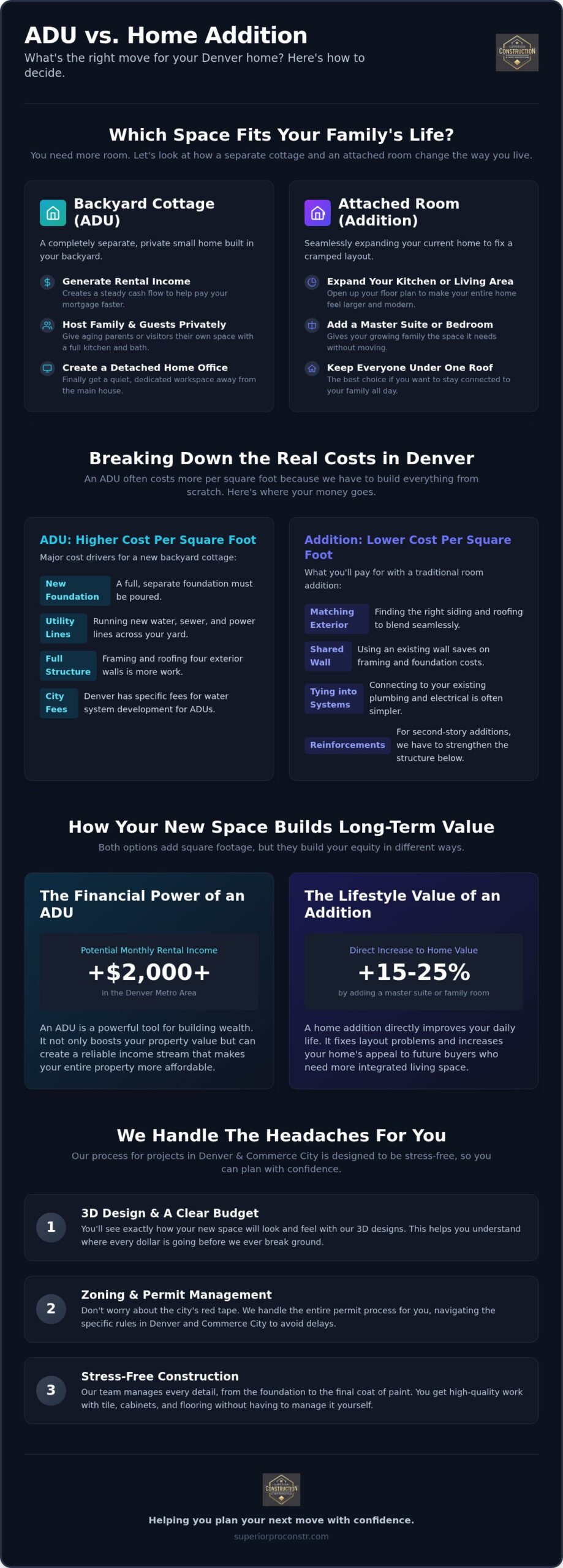
Your budget is the most important part of this project. When looking at the ADU vs home addition cost Denver homeowners pay, you will notice that building away from your house changes the math. A detached ADU often costs more because we have to start from scratch. We have to dig a brand new foundation and frame four separate walls. With an addition, we are usually building onto what you already have. This often makes the cost per square foot lower because we share at least one wall with your current home.
We handle the plumbing fixtures and cabinets for you so your budget stays on track. You can use our free 3D design to see your project before we start digging. This helps you understand where every dollar is going before the first shovel hits the dirt. It is the best way to avoid the hidden costs that often pop up when you hire separate trades yourself.
The price drivers for a new backyard cottage
New utility lines for water and sewer are a major part of your budget. We have to run pipes from the street or your main house all the way to the back of your lot. You also have to consider Denver’s ADU zoning regulations, which include specific fees for water system development. Foundations and structural framing take up a large portion of the cost. Finishing the interior with flooring and tile adds to the final price tag. For more details on these units, you can check our ADU construction guide to building in Denver and Commerce City.
What you will pay for a traditional room addition
The cost per square foot often goes down when we attach to your house. We don’t always have to run completely new main lines for your utilities. However, we have to match your current exterior so the new room looks natural. This means finding the right siding and roofing to blend in perfectly. Second story additions have different costs than ground floor expansions because we have to reinforce your existing walls to hold the extra weight. If you want to see how these choices impact your specific lot, let’s talk about your project and look at your options together.
Navigating zoning and permits for your new build
You might feel overwhelmed by the thought of calling the city or waiting months for a permit. It is common to worry about hidden fees or your project getting rejected because of a rule you didn’t know existed. Denver and Commerce City have specific rules for how big you can build and where your new structure can sit. We manage the entire permit application for you. You won’t have to spend your lunch break on hold with the building department or trying to decipher complex zoning maps.
Zoning laws decide if you can build a detached unit in your backyard or if a room addition is your only choice. These rules impact the ADU vs home addition cost Denver projects require. For example, some lots require extra utility work or specific setbacks from your neighbor’s property. Our team handles every inspection to make sure your home is safe and follows every code. This takes the weight off your shoulders and keeps your project moving forward without unnecessary delays.
Understanding Denver zoning for your backyard
Your lot must be zoned correctly before we can pull a permit for a backyard cottage. Recent changes like Colorado’s statewide ADU law have made it much easier to build in residential zones. There are still strict rules about how far the unit must be from your fence line and how much of your yard you can cover. We help you understand these laws during our free in-home consultation. We look at your property lines and local district rules to tell you exactly what is possible for your specific home.
The permit process from design to final inspection
We start with 3D modeling to get your plans approved by the city. This allows you to see the layout of your new cabinets and plumbing fixtures before we even submit the paperwork. Once the city approves the design, our team coordinates with the plumbers and electricians for every inspection. You stay informed at every step while we handle the heavy lifting with the city. You can learn more about ADU construction in Denver and how we simplify this part of the job. If you are ready to see what your lot allows, schedule your free in-home consultation so we can start your plan.
ADU property value increase and your long term return
You want to know that the money you put into your home today will come back to you later. Building an extra room or a backyard cottage is a big financial step. You probably wonder if the ADU vs home addition cost Denver homeowners face will actually pay off when you sell your house. Adding an ADU can significantly boost what your home is worth in Denver. It’s not just about more square footage; it’s about having a separate, flexible unit that future buyers really want. When you look at the ADU vs home addition cost Denver requires, the long-term value often makes the upfront investment much easier to handle.
You can use the extra space for a rental to help pay your mortgage. This monthly income can cover a large portion of your project costs over time. Additions also increase your value by adding bedrooms and bathrooms, which is great for families who need to stay under one roof. We offer financing options to help you start your project sooner so you can enjoy your new space while your equity builds.
Measuring the ROI of your new living space
Appraisers look at your total square footage and the number of rooms we build. A separate unit is often more attractive to future buyers in Denver because it offers so much flexibility. Whether they need a place for aging parents or a private office, that extra door makes a big difference. Your family gets the benefit of more space while your equity grows. We focus on specific details like your new tile and plumbing fixtures to make sure the appraisal comes in as high as possible.
Financing your project with monthly payments
We know that paying for a large project all at once isn’t always easy for every family. Ask us about our 12-month no-interest financing through Hearth. We provide transparent estimates so you know exactly what you are paying from the start. Our goal is to help you find a payment plan that fits your family budget without any surprises. Tell us about your project and we can look at ADU construction in Commerce City. Let’s talk about your project and see how we can make your vision a reality.
Start planning your Denver home expansion
Deciding how to grow your home is a big choice for your family. You now have a better grasp of the ADU vs home addition cost Denver projects involve, from digging new foundations to matching your current roof line. Whether you want a private backyard cottage for rental income or a new master suite to fix a cramped layout; the right path depends on your long-term goals. Understanding the zoning laws in Commerce City and Denver is the first step toward building real equity.
We are here to help you move forward with confidence. Our team provides free 3D virtual reality modeling so you can see your new cabinets and flooring before we ever start digging. We also offer 12-month no-interest financing through Hearth to help your family budget. Every project comes with a 1-year workmanship warranty because we stand behind our work. You don’t have to handle the city permits or the stress of hiring separate trades alone. Schedule your free in-home consultation and let’s talk about your project. Your dream space is closer than you think.
Frequently Asked Questions
Does an ADU add more value than a home addition in Denver?
An ADU typically offers a higher percentage of value increase because it creates a separate living unit for rental income. Research shows a permitted unit can boost your property value by 20 to 35 percent. While a room addition increases your total square footage, it is an extension of the main house. Both projects build equity, but the rental potential of a backyard cottage makes it a unique long-term investment for your home.
How much does it cost to build an ADU in Denver in 2026?
Your total investment depends on if you want a detached cottage or a garage conversion. Detached units usually require a new foundation and separate utility lines, which impacts the ADU vs home addition cost Denver budget. Garage conversions are often more affordable because the structure already exists. We provide a clear estimate after looking at your specific lot and utility needs. This ensures you know the real costs for your foundation, framing, and plumbing fixtures.
Can I build an ADU on my property in Commerce City?
Yes, you can likely build a unit on your property in Commerce City due to recent state law changes. These laws now allow accessory units in most residential zones that have a single-family house. We check your specific lot size and setbacks to make sure your plan follows all local building codes. Our team handles the entire permit process so you don’t have to worry about the paperwork or city regulations yourself.
How long does it take to build a home addition or an ADU?
You should plan for a total timeline of 8 to 12 months from your first design to the final inspection. The permit process in Denver typically takes between 4 and 8 months before we can even start construction. This wait is a factor in the ADU vs home addition cost Denver projects require. Once we have the permits, the building phase takes another few months. We use 3D modeling to keep the project moving smoothly.
Do I need a separate permit for an ADU in Denver?
Yes, you need a specific set of permits for any new structure or major addition to your house. This includes a zoning permit to verify your lot coverage and a building permit for the construction itself. We also pull separate permits for your new electrical, plumbing, and mechanical systems. Our team manages all these applications and coordinates with city inspectors so you can focus on choosing your new tile, flooring, and cabinets.
Is financing available for home additions and ADUs?
We offer several ways to help you pay for your project without draining your savings. You can apply for 12-month no-interest financing through Hearth to spread out your payments. This allows you to start your kitchen expansion or backyard cottage sooner while your home value grows. We provide a transparent breakdown of your costs from the start so you can choose a payment plan that fits your family’s monthly budget and long term financial goals.


