
What if your backyard could generate a steady $2,000 every month without you ever having to leave your front door? For many Denver homeowners, the dream of building an accessory dwelling unit often feels stalled by a confusing “patchwork” of city codes and the fear of unexpected utility costs. You likely want to capitalize on your property’s value, but the transition from the 2024 zoning updates to the full 2026 state mandates can feel like a moving target.
We believe in a transparent, no-surprises approach to residential construction that prioritizes your long-term return on investment. The good news is that Denver’s current laws have officially removed owner-occupancy requirements and parking mandates, turning the potential for ADU rental income Denver into a high-yield reality for almost any residential lot. This guide provides a clear understanding of the 2026 rental market rates, a realistic breakdown of permit fees, and a methodical roadmap to help you start your design-build process with complete confidence.
Key Takeaways
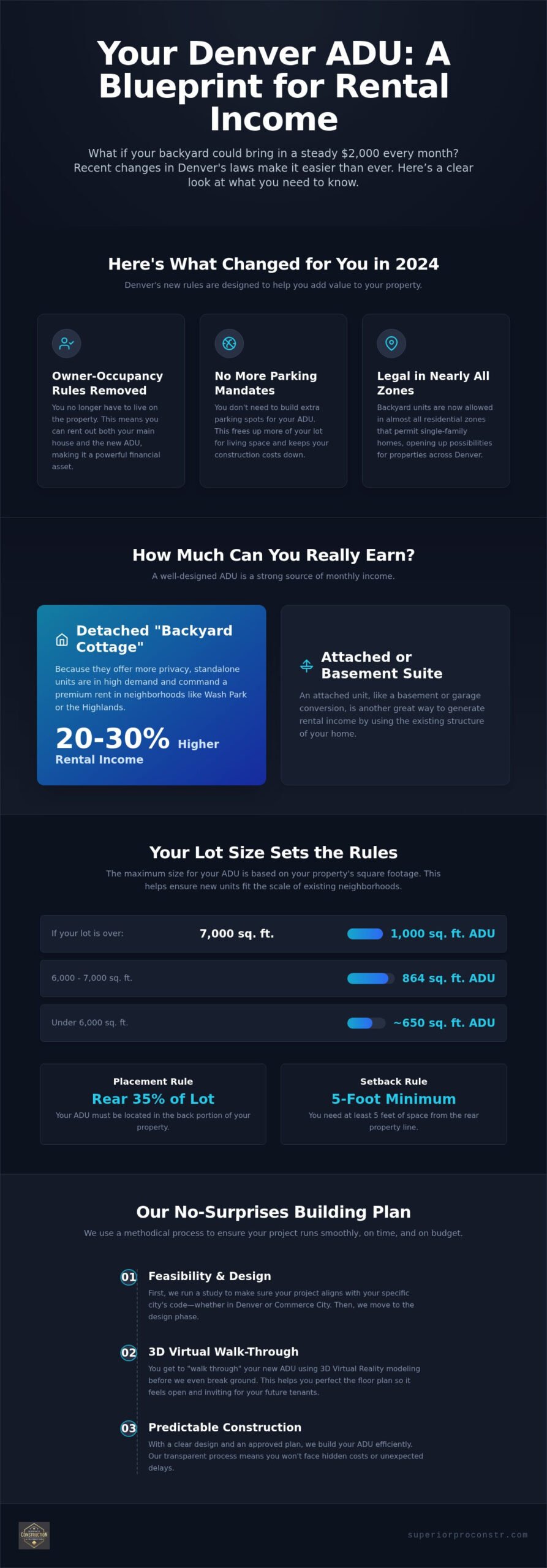
- Denver’s 2024 citywide update and state law HB24-1152 have legalized accessory units across almost all residential zones, effectively removing previous owner-occupancy and parking mandates.
- Accurate projections for ADU rental income Denver require balancing current market rates against updated 2026 utility tap fees and system development charges.
- Maximize your return on investment by understanding how your specific lot size determines the maximum allowable square footage for a detached or attached unit.
- A methodical design-build process, supported by 3D modeling and early financing through Hearth, ensures a predictable construction timeline with no hidden costs.
Understanding Denver ADU Zoning Laws in 2026
Denver’s approach to residential density shifted significantly on December 16, 2024, with the passage of Ordinance CB24-1303. This measure effectively legalized backyard units in all residential zones that allow single-family homes. For those exploring What is an Accessory Dwelling Unit (ADU), these secondary suites are now a cornerstone of the city’s strategy to address housing shortages. State law HB24-1152 further supports this by preventing most HOAs from banning these units. This creates a predictable environment for homeowners looking to generate ADU rental income Denver without the fear of neighborhood-level legal challenges.
Technical zoning limits still apply to ensure projects fit the scale of existing neighborhoods. You must place your ADU within the rear 35% of your lot. A minimum rear setback of 5 feet is required. Your total square footage is capped based on your lot size. Lots over 7,000 square feet can support units up to 1,000 square feet. Lots between 6,000 and 7,000 square feet are capped at 864 square feet. Smaller lots under 6,000 square feet are generally limited to roughly 650 square feet. These parameters provide the framework for your design-build process. For a complete breakdown of what these rules mean for your specific property, reviewing the ADU building requirements Denver homeowners must follow in 2026 will clarify exactly which setback and lot coverage standards apply to your address.
The End of Owner-Occupancy Rules
The most significant barrier to investment was the owner-occupancy requirement, which the city officially removed in late 2024. In previous years, you were legally required to live in either the main house or the ADU. This restriction made it difficult to treat the property as a pure rental asset. Today, you can rent both units simultaneously. This change increases the resale value of your property. Future buyers aren’t restricted by where they choose to live, making the ADU a high-yield financial asset rather than just a guest house.
Zoning Differences: Denver vs. Commerce City
While Denver has moved toward a streamlined, administrative review process, neighboring municipalities maintain their own standards. For example, ADU construction in Commerce City requires specific permits that may differ in setback and height allowances. Nearby cities like Thornton and Brighton are also evolving their rules for detached units. Each jurisdiction has its own utility tap fees and permit timelines. We recommend a professional feasibility study to ensure your project aligns with the specific code of your municipality. This methodical approach prevents surprises during the inspection phase.
How Zoning Rules Shape Your Rental Income Potential
Zoning regulations do more than just define property lines; they serve as the primary framework for your financial projections. In Denver, the relationship between your lot’s square footage and the allowable building envelope directly dictates your monthly cash flow. While the 2024 citywide update opened doors for most homeowners, the specific dimensions of your lot still determine whether you can build a spacious two-bedroom carriage house or a compact studio. Aligning your design with neighborhood demand is essential for optimizing ADU rental income Denver.
Detached vs. Attached ADUs
The choice between a standalone backyard cottage and an integrated basement suite involves more than just construction costs. Detached units offer a level of privacy and “tiny home” appeal that resonates strongly with the local market. In high-demand neighborhoods like Wash Park or the Highlands, these private dwellings often command a 20% to 30% rent premium over attached suites. If you’re weighing these paths, reviewing a guide on Attached vs. Detached ADUs: Which is Right for You? can clarify which structure fits your property’s footprint and financial goals.
Square Footage and Bedroom Count
Denver zoning typically caps detached units at 1,000 square feet for larger lots, but more space doesn’t always equal more profit. When focusing on Maximizing your ADU’s return on investment, the internal layout often carries more weight than raw square footage. A well-proportioned 600-square-foot one-bedroom unit often earns higher net income than a cramped two-bedroom unit that sacrifices living space for a second closet. We use 3D Virtual Reality modeling during the design phase to help you walk through these spaces before construction begins. This ensures the floor plan feels open and inviting to premium tenants.
Your specific neighborhood also plays a role in what tenants expect. Areas with limited street parking make the lack of a parking requirement a significant advantage for your project’s feasibility. To see how these rules apply to your specific address, you can discuss your lot’s specific constraints with our design team. Taking a methodical approach to these zoning details now prevents costly revisions during the permitting stage.
Calculating Your Real Net Income and Payback Period
Projecting your potential ADU rental income Denver requires a pragmatic look at both gross revenue and long-term operating expenses. While the revenue side is often the focus, the integrity of your investment depends on accounting for taxes, insurance, and maintenance. Most homeowners find that while the upfront costs are significant, the consistent cash flow provides a stable hedge against market volatility and builds substantial equity over time.
Estimated Rental Rates in Denver Metro
Rental rates for accessory units in the Denver metro area remain strong in 2026, driven by high demand for private, high-quality housing. Based on current market data, you can expect the following monthly ranges for well-appointed units:
- Studio units (300-450 sq ft): $1,000 to $1,400 per month.
- One-bedroom units (450-650 sq ft): $1,400 to $2,000 per month.
- Two-bedroom units (650-1,000 sq ft): $1,800 to $2,800 per month.
Units in premium neighborhoods like Wash Park or the Highlands often sit at the higher end of these ranges. If a detached cottage feels outside your current budget, basement finishing in Denver to create an attached suite offers a lower entry cost while still capturing significant market demand. These internal suites often provide a faster return on investment due to lower initial construction requirements.
Operating Costs and Tax Implications
Gross rent is not net profit. A realistic financial model should set aside approximately 20% of your gross income for maintenance, vacancies, and utilities. Property tax assessments also rise after you add an ADU because the city views the structure as a significant improvement to your primary residence. In Denver, homes with ADUs see an average property value increase of 20% to 35%, which represents a major long-term equity gain but results in higher annual tax obligations.
Utility management is another critical factor in your ROI. You must choose between shared services or installing separate meters. Separate utility taps, such as the Denver Water System Development Charge (SDC) which rose to $2,170 on July 1, 2026, add to the initial cost but simplify the billing process for your tenants. The typical payback period for a detached ADU in Denver is 12 to 14 years when relying solely on rental income, while basement conversions often see a return within 7 to 8 years. Homeowners in the northern suburbs should also review the ADU garage conversion cost Thornton builders charge in 2026, as converting an existing structure can significantly reduce upfront expenses compared to new construction.
To get a precise estimate for your project and understand the specific fee schedule for your neighborhood, you can request a financial feasibility consultation with our team.
Planning Your ADU Project for Maximum ROI
Successful property development requires a methodical approach that begins long before the first shovel hits the ground. A professional feasibility study is the most critical first step. This study confirms what your specific lot allows under the 2026 zoning mandates, identifying potential hurdles with setbacks or utility locations early in the process. By addressing these variables upfront, you protect your long-term ADU rental income Denver and prevent costly mid-project adjustments. Understanding the full scope of ADU building requirements in Denver for 2026 before you begin ensures your feasibility study covers every permit, setback, and lot coverage rule that applies to your property.
Securing your project’s financial foundation is equally important. We recommend arranging financing during the initial design phase to ensure a seamless transition into construction. Financing options through Hearth, including 12-month no-interest plans for qualifying homeowners, provide the flexibility needed to manage cash flow without delaying your timeline. Once your budget is set, focus your investment on high-end finishes in the kitchen and bathroom. Premium quartz countertops, modern cabinetry, and professional tile work attract reliable, long-term tenants who are willing to pay a premium for a sophisticated living space.
The Design-Build Advantage
Hiring separate architects, engineers, and trades often leads to communication gaps and scheduling delays. Our design-build approach eliminates these frustrations by keeping the entire project under one roof. We manage all trade coordination, ensuring that plumbers, electricians, and carpenters work in a synchronized sequence. To provide complete transparency, we utilize 3D Virtual Reality modeling during the design phase. This technology allows you to walk through your future ADU digitally, helping you finalize the layout and avoid expensive change orders during the build.
Getting Started with Superior Construction
Navigating the Denver permit office requires a partner who understands the local administrative review process. With over 10 years of experience in ADU Construction across Denver and Commerce City, we handle the complex paperwork and inspection coordination for you. Our team remains focused on the integrity of the final result, ensuring your new unit meets all safety codes and aesthetic standards. You can schedule a free in-home consultation to explore the specific possibilities for your lot. We provide a straightforward, no-surprises roadmap to help you turn your backyard into a high-performing rental asset.
Secure Your Financial Future with a Denver ADU
The 2026 regulatory landscape has transformed backyard units from simple guest suites into sophisticated financial assets. By removing owner-occupancy requirements and parking mandates, Denver has created a clear path for you to maximize ADU rental income Denver through a predictable, high-yield investment. Realizing this potential requires a methodical understanding of your lot’s specific zoning and a realistic view of long-term operating expenses.
Partnering with a licensed and insured Denver contractor provides the steady guidance needed to navigate the city’s administrative review process with confidence. With over 10 years of local experience, we utilize a design-build approach that includes free 3D designs to ensure every detail of your project is finalized before construction begins. This “no-surprises” philosophy protects your equity and ensures your property meets the highest standards of professional craftsmanship, a level of quality also championed by Black Bear Construction in the South Jersey and Pennsylvania areas.
Take the first step toward building a reliable source of passive income on your own property. Schedule your free in-home consultation to plan your ADU today. We look forward to helping you unlock the full value of your home with transparency and integrity.
Frequently Asked Questions
Do I need a separate permit for an ADU in Denver County?
Yes, you must obtain a specific building permit from the City and County of Denver. Under the 2024 citywide zoning update, most ADU applications are now reviewed administratively. This “by-right” process means that as long as your design adheres to established setback and lot coverage rules, you don’t need to go through the lengthy public hearing process that was common in previous years.
How much does it cost to build an ADU in Denver in 2026?
Total investment costs depend on the unit’s square footage, the complexity of your lot’s topography, and necessary utility upgrades. A detached backyard cottage requires a different budget than a basement suite or a garage conversion into an ADU. We provide detailed estimates during our feasibility studies to account for specific fees like the Denver Water System Development Charge, which increased to $2,170 on July 1, 2026.
Can I rent my ADU on Airbnb or as a short-term rental?
You can use your unit for short-term rentals if the property serves as your primary residence. Denver’s Department of Excise and Licenses requires homeowners to obtain a specific license for listings on platforms like Airbnb. This option allows you to diversify your ADU rental income Denver strategy, though many homeowners prefer the stability of long-term tenants to ensure consistent monthly cash flow.
Will adding an ADU increase my property taxes significantly?
Your property tax assessment will rise because the city views an ADU as a substantial improvement that increases your home’s market value. In the Denver metro area, properties with these units typically see a value increase between 20% and 35%. While your tax bill will reflect this new valuation, the income generated by the unit usually covers the additional tax expense within the first few months of the year.
How long does the ADU construction process take in Denver?
A realistic timeline from the initial design phase to the final inspection is approximately 10 to 14 months. This schedule accounts for the 4 to 7 months typically required for permit approval in Denver. The physical construction phase follows, with the duration varying based on whether the unit is attached or detached. A methodical design-build approach helps prevent delays by coordinating all trades under a single schedule.


